The Man Who Reads Shells With His Hands
A conversation with Geerat Vermeij, the blind UC Davis biologist who changed how we think about evolution
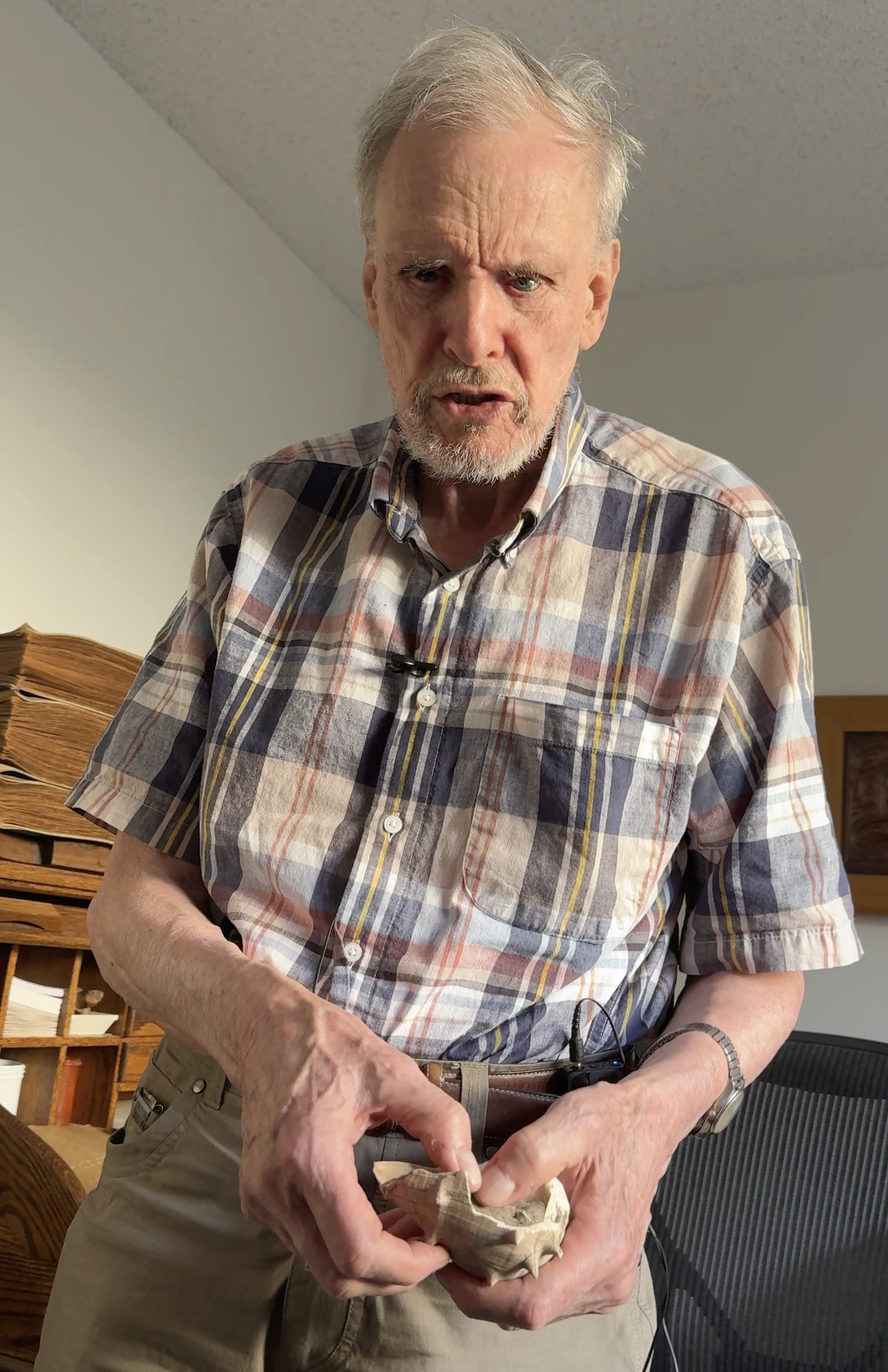
In September, my colleague Tod Mesirow and I drove to Davis and spent an afternoon with Geerat Vermeij at his home. Vermeij is one of the world’s great living malacologists, a scientist who studies mollusks. His discoveries about predation, adaptation, and evolutionary arms races changed how scientists read the history preserved in shells. Oh, and he’s blind.
The house is modest, and Vermeij’s cramped office is full of shells and paper, including stacks of the New York Times Book Review, all in Braille. Cabinets also hold manuscripts, books, and decades of notes, again, mostly in Braille. American Scientist magazine has called him “One of the master naturalists of our time.”
Vermeij, who goes by Gary, was born in the Netherlands in 1946, lost his sight to childhood glaucoma, and moved with his family to New Jersey when he was nine. A fourth-grade teacher’s box of Florida shells set the course of his life. He went on to Princeton and Yale and became one of the best-known shell scientists in the world. He won a MacArthur “genius” grant in 1992 and is a member of the National Academy of Sciences. He is now a distinguished professor emeritus at UC Davis.
He has written many acclaimed books, including A Natural History of Shells and The Evolution of Power: A New Understanding of the History of Life, which we discussed in the interview.
His big idea came from his fingertips. Running his hands over thousands of shells, he felt scars where crabs and fish had tried and failed to break in. From those repairs, he built the theory he calls escalation: that predators and enemies, more than anything else, drive the history of life toward ever more powerful creatures.
We talked about going blind, arms races in the ocean and the Cold War, and why he worries that AI will make people stop looking. The conversation has been edited for length and clarity.
On going blind
How did you become blind, and what did it mean for your life early on?
I had childhood glaucoma, which was probably caused by German measles when my mother was pregnant. That was pretty common right after the war. And at the time, Princess Juliana of the Netherlands had the same issue. She gave birth to a daughter who also became blind, in very much the same way that I did. Juliana, who then became the queen, came to visit her daughter and me, because we were in adjacent rooms in the hospital, apparently. I don’t remember any of this, because I was much too young.
The final operation took place when I was about three and a half. From that point, I became totally blind.
I was under the care of Holland’s most prestigious eye surgeon, Professor Weve, who counseled my parents very wisely: send him to school right away, and treat him just as you do your older son, who was not blind. Which is what my parents did. The Queen, by the way, did not. And her daughter did not do all that well in life.
On shells
How did you develop an attraction to shells?
Both my parents were quite good natural historians, so we would often go on the bicycle to places in the polder (low, flat land in the Netherlands that was reclaimed from the sea). I took to natural history right away, even as the very smallest kid.
Then, when I was nine, we moved to New Jersey. The environment in northwestern New Jersey was so radically different from what I experienced in Holland that it really made me ask questions, in a childlike fashion. Why is this place so different? I had always liked shells on the beach in Holland, in Scheveningen and so on. But when I came to the U.S., I had a fourth-grade teacher who brought shells to her classroom from the west coast of Florida. And, good gracious, they were so different from anything I had observed before. I just fell in love with them and wondered why they were so much more beautiful than the ones I collected in Holland, much as I liked those.
That got me going in a scientific direction. Never any doubts about that. Science and natural history were there from the get-go.
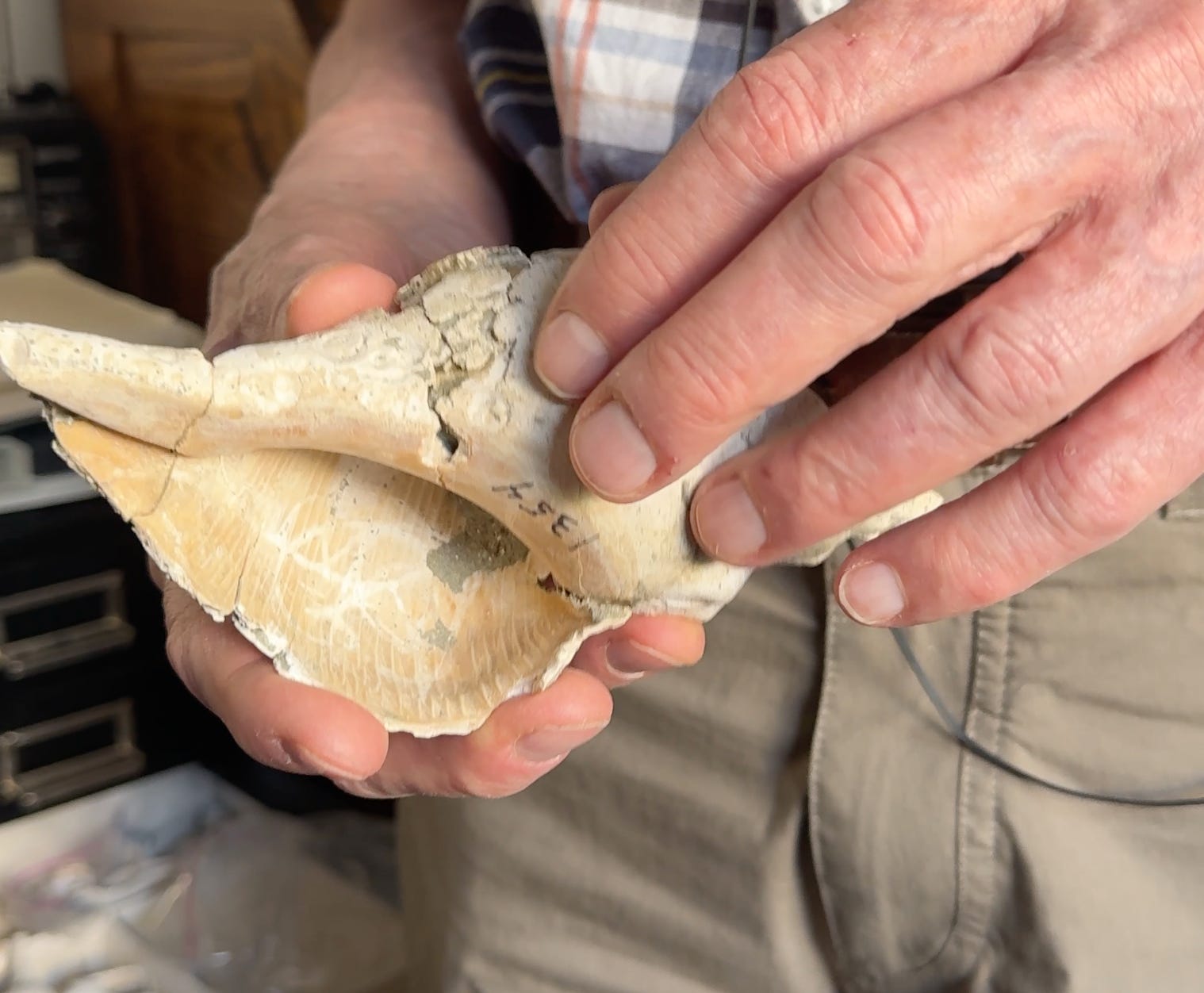 Geerat Vermeij holds a fossil shell damaged by a predator. Through touch, he reads a history in the shell that others might miss. (Photo: Erik Olsen)
Was there religion in your upbringing?
Well, in a way, oddly enough. When I was much younger, I was sort of infatuated with stories about Jesus. But — there’s a great big but here — at age eight, I began to realize that this stuff is basically nonsense.
We were forced in the school for the blind to go to Sunday school. And this hapless teacher said, “Now let us give back to God a little bit of what he gave to us.” We were all supposed to give a penny. I raised my hand and said, “What is God going to do with money?” She said, “Well, he’s going to do all kinds of good things.” And I said, “But that’s people doing it, isn’t it? It’s not God.”
For me, that broke the entire thing. I was eight at the time, and I never looked back.
It surprised me to hear you, as a blind person, describe the beauty of shells. What does that beauty feel like to you?
Beauty, like power, has many dimensions. For me, having wonderful sculpture on the shell, or the contrast between the smooth inside and the more sculptured outside — the tactile beauty is very strong. I love natural history for that reason. But there’s also aural beauty, smells. Multidimensional beauty. You have to develop a sense of aesthetics, which comes with careful noticing, awareness, observation. That’s always been part of me. I immerse myself in the works of nature. I’ve never been fond of cities, to put it mildly.
Do you think a sighted person experiences a shell the way you do?
A lot of sighted people think shells are beautiful. Otherwise, they wouldn’t be collecting them. I think most people who get into shells have a pretty strong aesthetic sense, which in their case is probably more visual and, of course, deals with color. But I don’t think my sense is any greater than theirs. It’s different, but not greater.
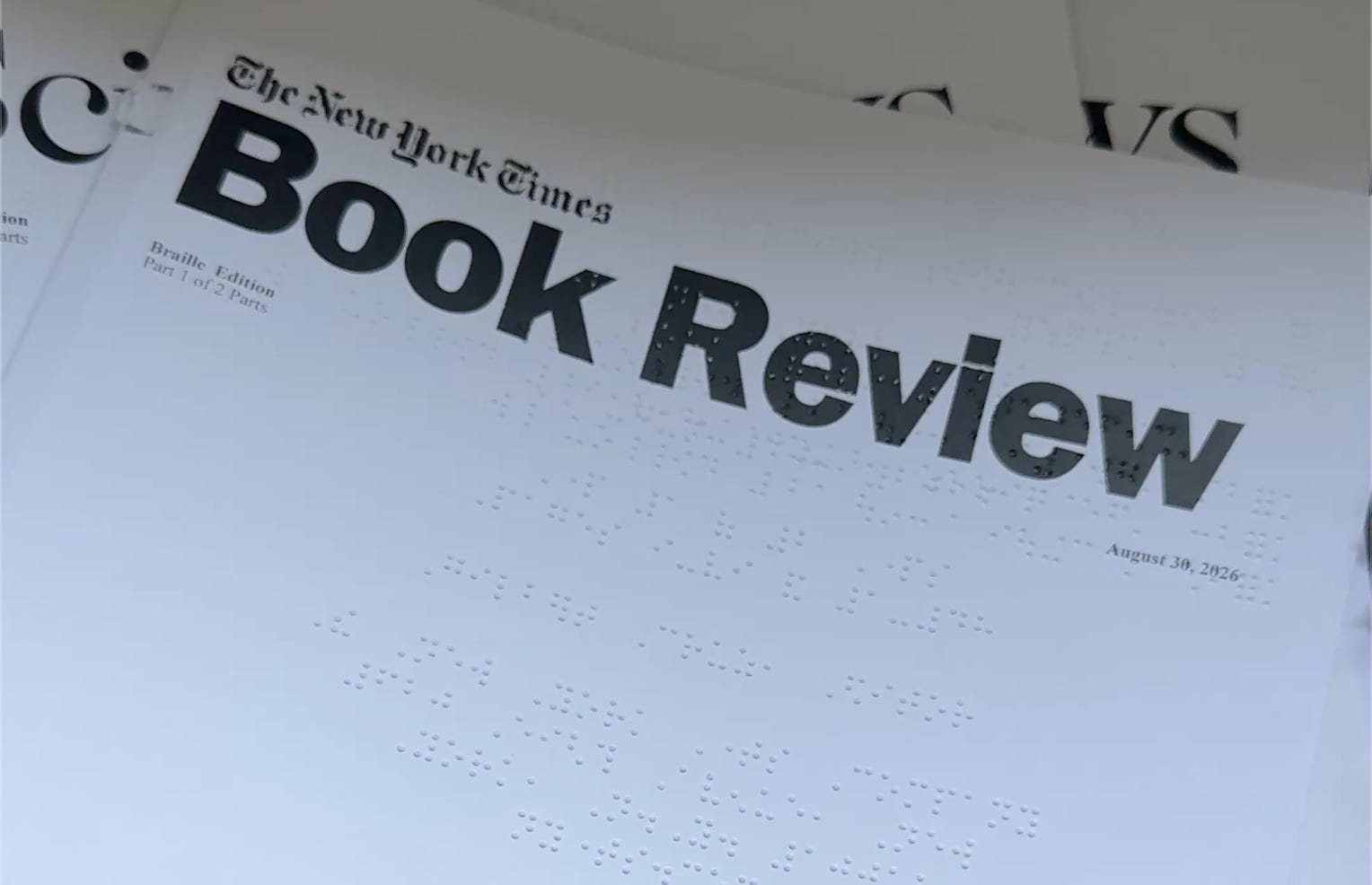 Vermeij is a voracious reader, all in Braille. (Photo: Erik Olsen)
On becoming a scientist
When did you decide you could actually make a living at this?
From the very beginning I said, I want to be a conchologist, somebody who studies shells. Then I broadened that, because I realized that shells are parts of animals, after all. Intimate, functional parts of animals. So then I said I want to be a malacologist, somebody who studies mollusks. And then I broadened that to say, I’m going to be a biologist. And that got broader still.
At Princeton it was all very planned, with the aim of securing employment. Probably a fool’s errand in many ways, because blind people didn’t become scientists. Options were not great. The New Jersey State Commission for the Blind knew that, and they tried to dissuade me from majoring in biology. I said, fine, we’re going to call it paleontology. And they said fine, not knowing anything about it, of course.
Really?
Yes. And several faculty members at Princeton wrote the commission a letter saying, “His future is none of your business. It’s our business.” Very supportive faculty.
Then you went on to Yale.
I went to Yale because it had the Peabody Museum of Natural History and its collections, and the whole museum thing has always appealed to me. And of course I’m lucky as can be, because at Yale I met Edith, a fellow graduate student, and that was great.
How do you read the scientific literature?
Edith and my assistant read to me all the time. All these things in my cabinets and all over the place are manuscripts, books, things I’ve read. I’ve read something on the order of 30,000 papers and books over the years, and I have notes for all of them in Braille. That’s why my bibliographies tend to be long.
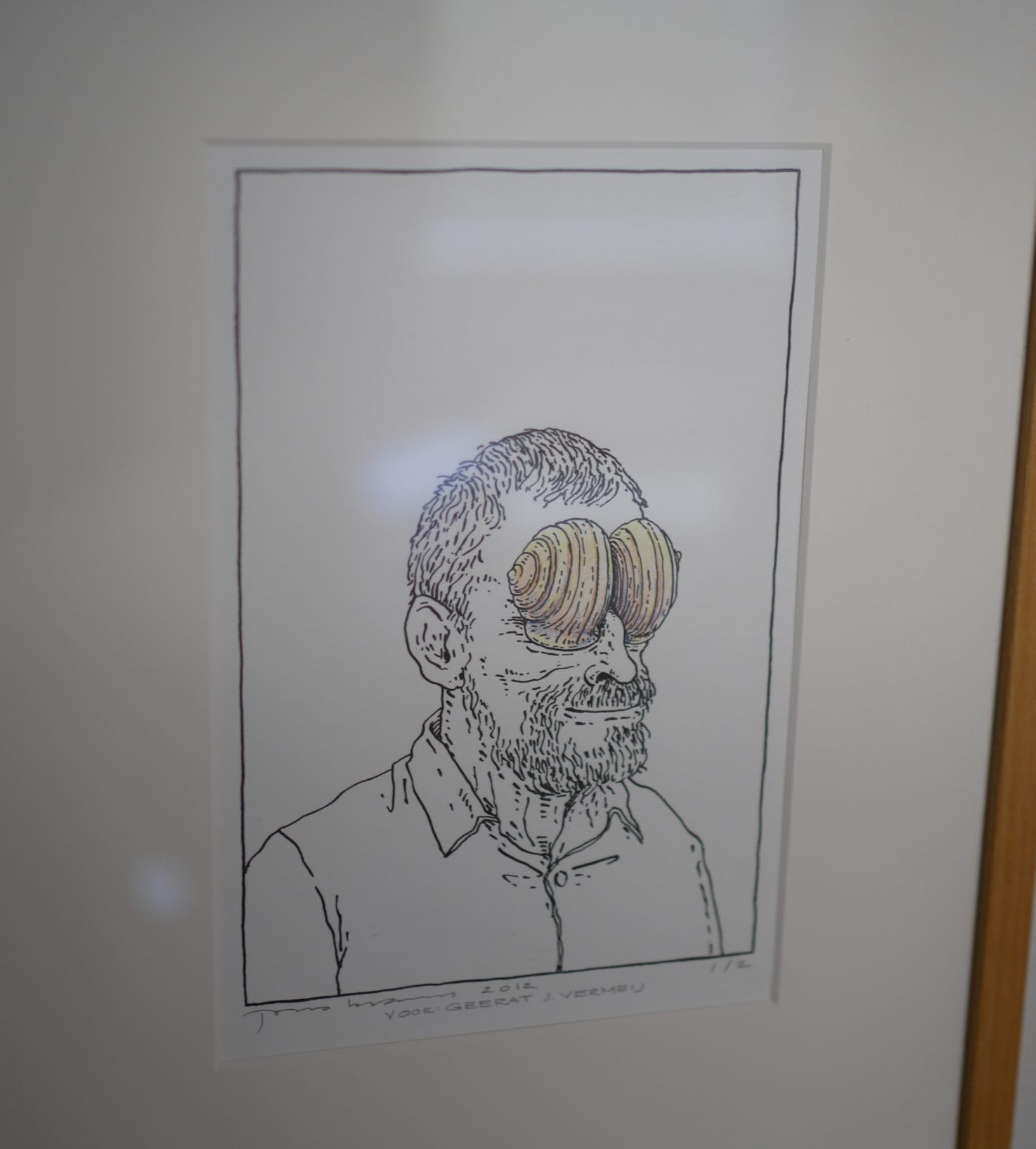 A cartoon drawing on his wall. (Photo: Erik Olsen)
On noticing what others missed
Your blindness may have given you abilities that others don’t have. How did you come to realize that?
I noticed features of shells that people easily overlooked. There’s a fossil from Florida I was handling once, and I noticed that as I rubbed the shell one way, it’s rougher than if I go the other way. The concentric ridges, the ones that parallel the growing edge of the shell, are asymmetrical. They’re imbricated, like roof tiles.
Not only had nobody ever noticed that, but when people see it, they say, “Oh yeah, I can see that.” People have written papers about these shells; they’ve been known for more than a hundred years. Nobody ever noticed it.
It’s that kind of thing that I’m apt to notice where other people might not.
Did observations like that cohere into a bigger set of ideas?
You have to make observations with, as I like to say, your brain in gear. You have to think about things as you observe them.
There was an incident, which I discuss in my autobiography, that was very influential, and almost sounds like a random event. I was in Guam with Lu Eldredge, who was at the University of Guam. We were walking across the reef flat at Pago Bay toward the reef edge, and somewhere in the middle, Lu bent down and picked up a cowrie shell that was broken. He handed it to me, and the amazing thing about it was that, aside from being broken, it was in extremely good condition, still very polished. And he said, “Yeah, the crabs in my tank do this.” And I thought, how fascinating.
I had earlier recognized that many of the shells in the tropics, particularly in the tropical Pacific, are heavily armored. And it occurred to me that this damage, and also repaired damage in shells, is trying to tell me something. Most shell collectors want pristine specimens with no blemishes. But the blemishes, the repaired scars, which look kind of ugly, are telling me something terribly important. The repairs indicate that the shell was sufficiently designed, if you will, to withstand some pretty hefty predation pressure. That’s where natural selection comes from. It’s when predators fail and leave a mark that I can find.
That was a revelatory event, and it essentially changed my career.
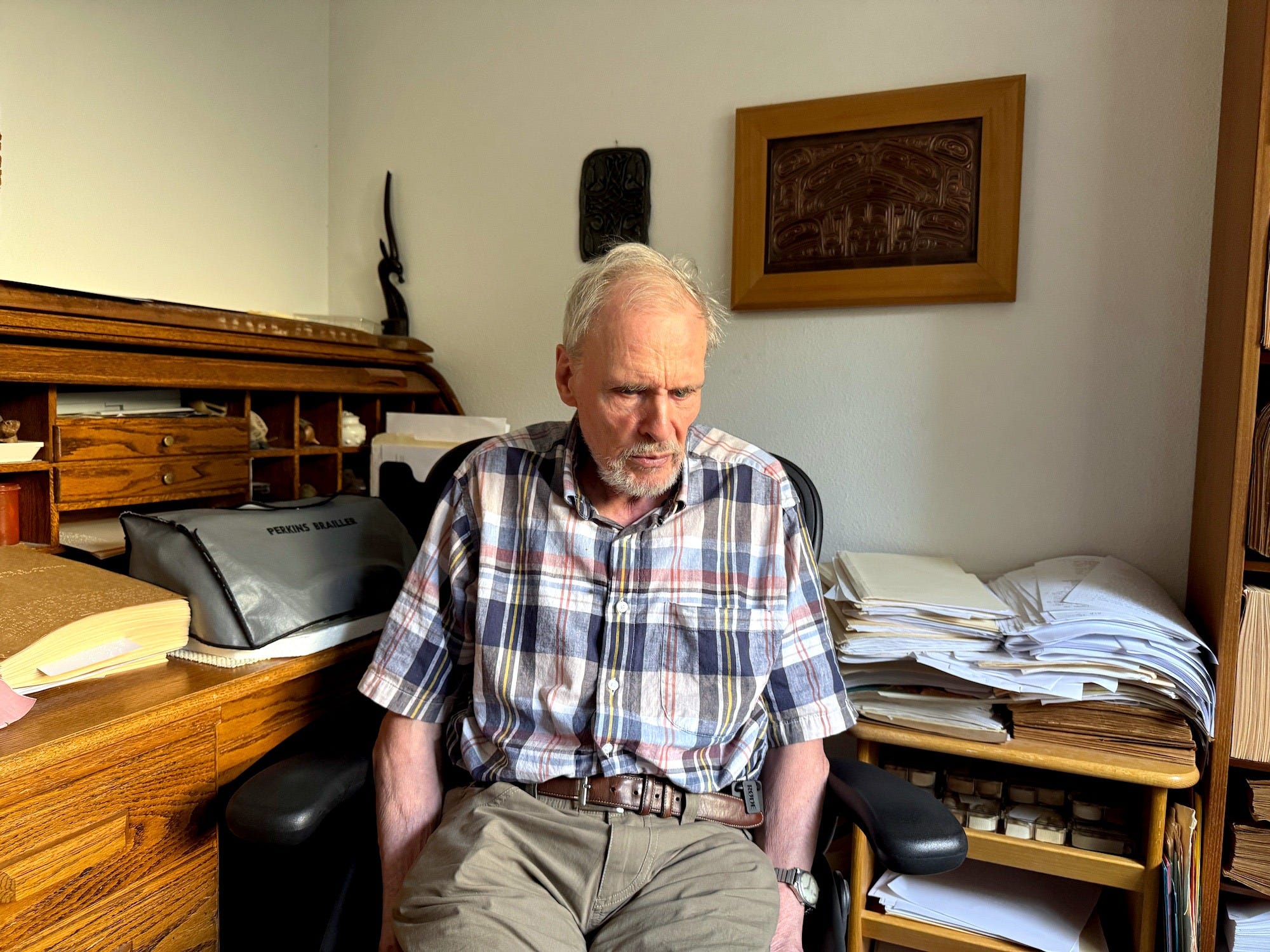 Vermeij in his home office in Davis, California, near UC Davis, where he joined the faculty in 1989 and taught for more than three decades. (Photo: Erik Olsen)
On escalation
It’s an arms race?
It’s an arms race argument. I had looked at a lot of Paleozoic snails, and I recognized for a long time that they didn’t really look like modern snails. It hit me that the way in which they don’t look like modern snails is that they did not have the kind of armor I was seeing in so many tropical shells today. In other words, armor increased over time. And the predators that might be responsible did the same thing. In the Paleozoic we did not have such powerful predators as we do today. So there was this arms race.
Then came the question: We know how arms races get started, but we don’t know how they end. That got me into economics. I was having these ideas when Ronald Reagan came into power, and he said he could design a fail-safe missile system to defend the United States. I said, no, there’s probably no way of doing that. But it made me wonder, what is it exactly that makes arms races in nature and in the human sphere end? So I started thinking about parallels between the human economy and the economies of nature. That continued for decades.
Why do you call it escalation rather than an arms race, or coevolution?
There’s a famous idea that Dawkins and Krebs came up with in 1979, the so-called life-dinner principle. It’s a cool idea, even if it isn’t totally correct. If a predator fails, all it loses is its dinner. If the prey fails, it’s dead. There’s something truthful about it. From an evolutionary perspective, the prey in a sense has a greater advantage than the predator does. But the predator has more power. So you get a dynamic which I prefer to call escalation, rather than coevolution, because of that inherent asymmetry in power.
Escalation, in effect, is enemies running the show. Predators, or top competitors. The others adapt too, but they are more limited in their power. It’s the enemies that are running much of adaptive evolution.
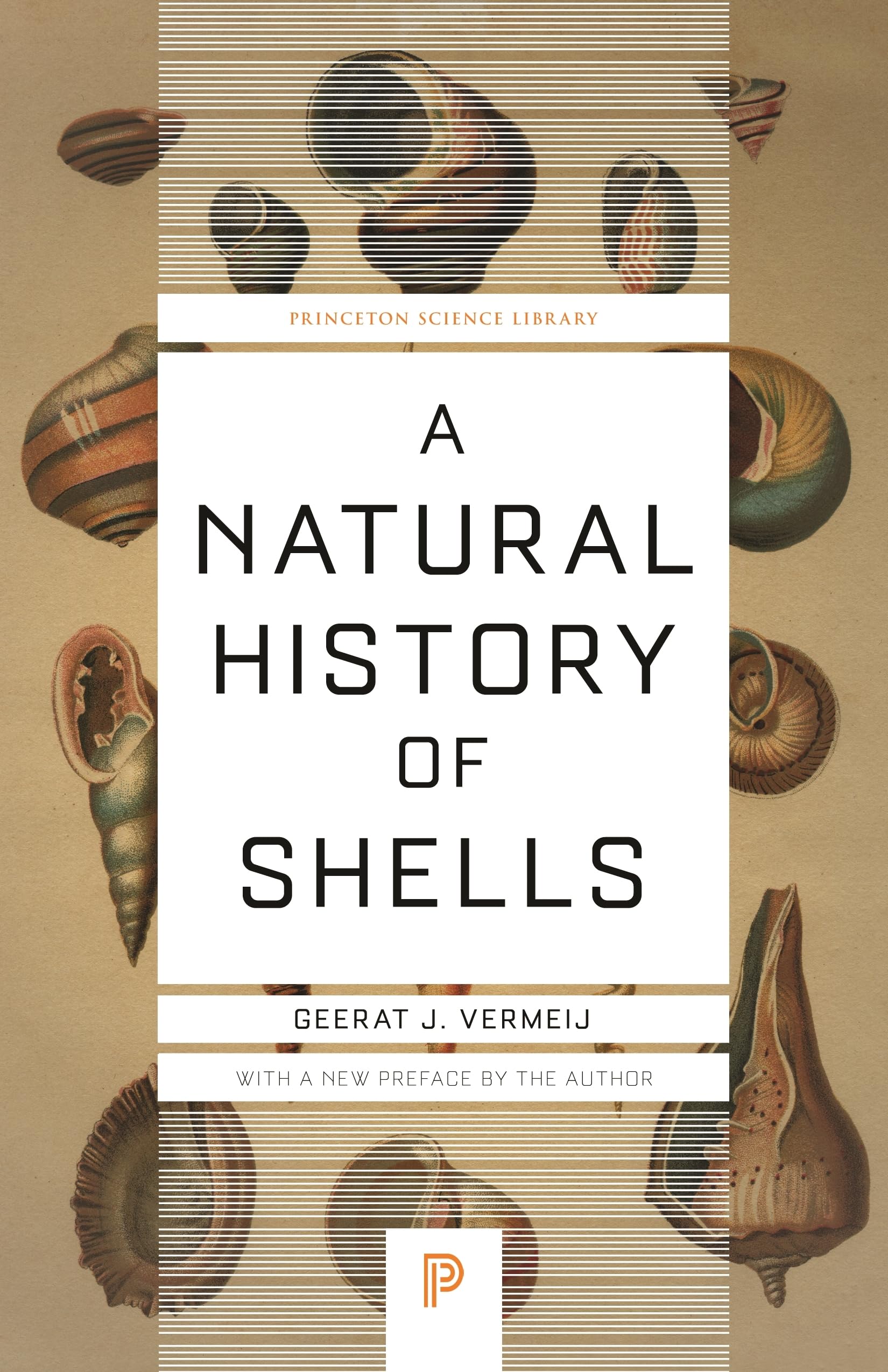
Vermeij is the author of many books, including A Natural History of Shells.
On being a renegade
Have you had intellectual opponents along the way?
Oh, yes. And that continues. I have a strongly adaptive perspective on evolution. I tend to think that organisms are adapted almost by definition, simply because if they weren’t, they wouldn’t be there. Early in my career, it became fashionable, thanks to Stephen Jay Gould and Richard Lewontin, to downgrade both natural selection and adaptation. That perspective is still current in many quarters. I strongly disagree with it.
My perspective on power is not universally loved. And that’s okay. I’m a renegade in many respects and almost expect criticism. It can be annoying, to be sure. But that’s part of life being a creative scientist.
How do you think your work will be remembered?
Not well. The power book in particular has been very disappointing to me, because it was never really reviewed in journals like Science and Nature, which should have done it. I think most people are unaware of it. Obviously, I think I am right. I think power and its evolutionary implications are exceedingly important. I wish more people thought so.
On AI
Do your ideas about power have implications for society?
I think they do, for example, with AI, where everyone is worried, as am I. There’s no doubt that AI has to be regulated. In nature, regulation is almost always very diffuse, coming from many different sources. I think that’s the best way to run an economy, or a nation: diffuse regulation that comes from below rather than only from above. I don’t advocate for no government; that’s ridiculous. But the importance of diffuse regulation by many different agents does have implications for how we should run something like this super-powerful AI.
What’s your biggest concern?
That people will not be able to think for themselves. Everyone will think, well, AI knows it all, so why do we need to do any research? But one thing AI so far has not been able to do is make observations and ask questions about them. I think that is an important scientific human activity that I value above most everything else. My worry is that people are downgrading that ability because they think AI will solve it all.
AI will help with inventing proteins and vaccines, legitimately so. My main quibble is with observations that AI cannot know because they haven’t been made.
What’s left
Are there big questions you won’t get to?
Oh, yeah, loads. The Cambrian explosion: How did it really get going? Is there a trigger? Why, with very high CO2 concentrations in the Eocene, weren’t the oceans acidified? They weren’t. There were lots of thick shells, lots of calcification going on. Why not? I really do not know. I would love to know.
There are lots of questions like that gnawing at me. I keep a scientific notebook where I write these questions, possible answers, many of which turn out to be wrong, and comments on papers I read. I go back to it all the time, and sometimes I think, this is worth pursuing. And then I do it.
Thanks for reading! As an Amazon Associate, I earn (very little) from qualifying purchases.